


Thank you! Your submission has been received!
Oops! Something went wrong while submitting the form.
Looking for a Grafana IRM alternative or a Grafana On-Call alternative? Discover why DevOps teams choose ilert’s AI-first incident response for reliability.



























With the announcement that Grafana On-Call OSS has entered maintenance mode and is scheduled for deprecation on March 24, 2026, many teams are re-evaluating their incident response strategy. While Grafana is pushing users toward its unified Grafana Cloud IRM, many DevOps and SRE teams are looking for a vendor-neutral, AI-first solution that doesn't lock them into a single observability silo.
ilert provides a robust, purpose-built Grafana IRM alternative that bridges the gap between your various monitoring tools and actionable resolution. Whether you are looking for a Grafana On-Call alternative to avoid cloud lock-in or simply need a more intuitive incident management platform, ilert offers the speed, flexibility, and AI-driven insights required for 24/7 operations.
While both platforms are leaders in their respective areas, understanding their distinct approaches will help you make a more informed strategic decision.
While Grafana IRM is built as a component of a larger observability suite, ilert is an AI-first incident management platform from the ground up. While Grafana IRM excels at surfacing deep data from your observability stack and Grafana Sift agent diagnoses incidents, ilert’s AI SRE focuses on what happens next. Our AI SRE doesn’t just show you data; it investigates, explains, and can even autonomously resolve incidents. By correlating metrics across your entire stack, ilert reduces noise and provides responders with clear, actionable context the moment an alert triggers.

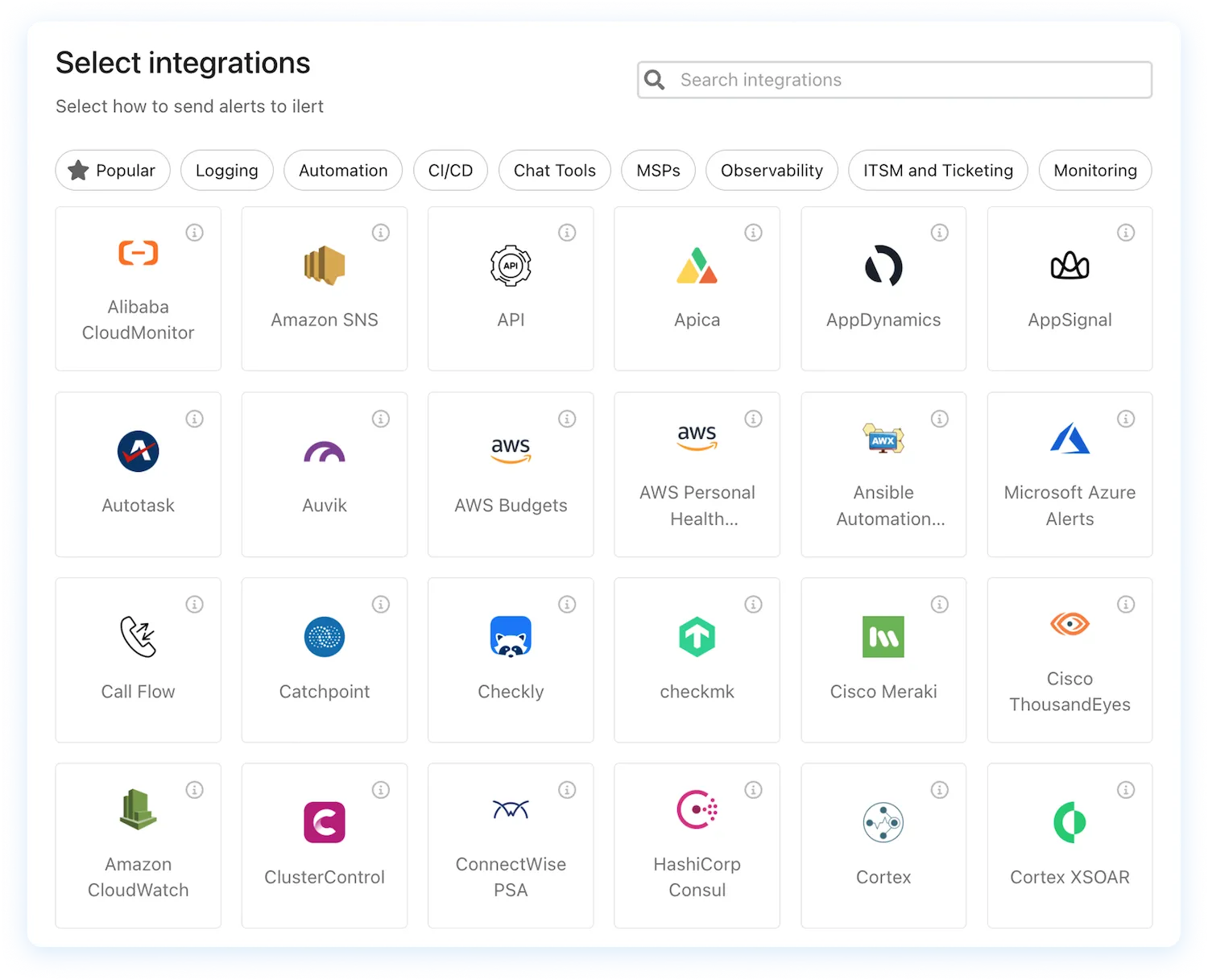
Choosing a Grafana IRM alternative, such as ilert, gives your team the freedom to use the best monitoring and observability tools for the job. ilert integrates natively with dozens of sources. Unlike Grafana Cloud IRM, which is optimized for its own ecosystem and offers a limited number of integrations, ilert serves as a centralized "mission control" that remains functional and accessible even if your primary observability provider experiences downtime.
Moreover, ilert is built on a philosophy of true vendor neutrality, constantly adding more inbound, outbound, deployment, and MCP integrations. This ensures your incident response remains functional and your data remains accessible, regardless of which tools you choose to use today or tomorrow.
A critical safety net for any SRE team is the ability to detect when monitoring systems themselves stop reporting. ilert includes built-in heartbeat monitoring that allows teams to define expected signals from monitoring tools or services and trigger alerts if those signals are missed. Because ilert operates independently from the monitored observability stack, it can notify responders when a Grafana instance or an entire alerting pipeline becomes silent.
Grafana approaches this challenge differently. In Grafana Cloud IRM, teams can configure heartbeat-style integrations and meta-monitoring to alert when expected signals or alert evaluations stop occurring. This allows organizations to monitor the health of their alerting and observability pipelines within the Grafana ecosystem. However, these safeguards rely on Grafana Cloud’s infrastructure itself, meaning they are typically configured and monitored from within the same platform they are designed to supervise.


For many organizations, incident management starts with an urgent phone call from a customer or an automated system. How these calls are handled can be the difference between a 2-minute resolution and a 2-hour outage.
ilert offers a sophisticated, node-based Call Flow builder that allows you to design complex voice journeys with ease. Using a drag-and-drop interface, you can create multi-level IVR menus ("Press 1 for Support, Press 2 for Engineering"), implement time-based routing, and even deploy an AI Voice Agent that interacts with callers in natural language to gather context before paging an engineer. This ensures that every call is routed with precision and that responders are equipped with the right information the moment they pick up.
In contrast, Grafana IRM provides a more basic "Live Call Routing" feature. While it allows you to route incoming calls to on-call engineers, the setup is often more manual and lacks a visual logic builder. To achieve advanced functionality, such as sophisticated IVR menus or conditional branching, Grafana users typically have to rely on complex third-party integrations with tools like Twilio Studio. For teams looking for a native, all-in-one solution that handles voice as a first-class citizen, ilert’s Call Flows provide a level of depth and professional automation that is difficult to replicate within the Grafana ecosystem.
Transparency is key to modern incident management, yet how you achieve it differs significantly between ilert and Grafana IRM platforms.
ilert provides fully integrated public, private, and audience-specific status pages. This allows you to convert any incident into a status update with a single click, keeping customers and internal stakeholders informed in real-time without leaving your incident response workflow. By having status pages built-in, ilert eliminates the need for separate subscriptions and reduces the manual overhead of syncing data between tools.
In contrast, Grafana IRM does not currently offer a native status page product within its suite. To communicate with external stakeholders, Grafana users typically rely on integrations with third-party tools like Atlassian Statuspage. While Grafana can send alerts to these services via webhooks or dedicated integrations, it requires managing a separate vendor, maintaining additional configurations, and often results in a fragmented experience where the "source of truth" for the incident is split between your observability data and your communication platform.