Runbooks are history: Why agentic AI will redefine incident response forever



If you’re an SRE, platform engineer, or on-call responder, you don’t need another article explaining incident pain. You feel it every time your phone lights up in the middle of the night. You already know the pattern:
- Noisy alerts that drown out real issues
- Slow, manual triage
- Scrambling through tribal knowledge just to understand what’s happening
You’ve invested in runbooks, automation, observability, and “best practices,” yet incident response still feels like firefighting.
Now imagine the same midnight page, but with AI SRE in place:
- A triage agent instantly isolates the one deployment correlated with the CPU spike
- A causal inference agent traces packet flows and identifies a library-induced memory leak
- A communication agent drafts the root-cause summary
- A remediation agent rolls back the offending deployment, all within seconds
What once took hours is now finished in a couple of minutes.
This article is a short preview of our Agentic AI for Incident Response Guide. The goal: show you why the runbook era is ending and that AI SRE can fundamentally change how your team handles incidents.
The problem: Why incident response is stuck
Even the best engineering teams are hitting the same wall. The challenge isn’t effort, but it’s the model we’re relying on.
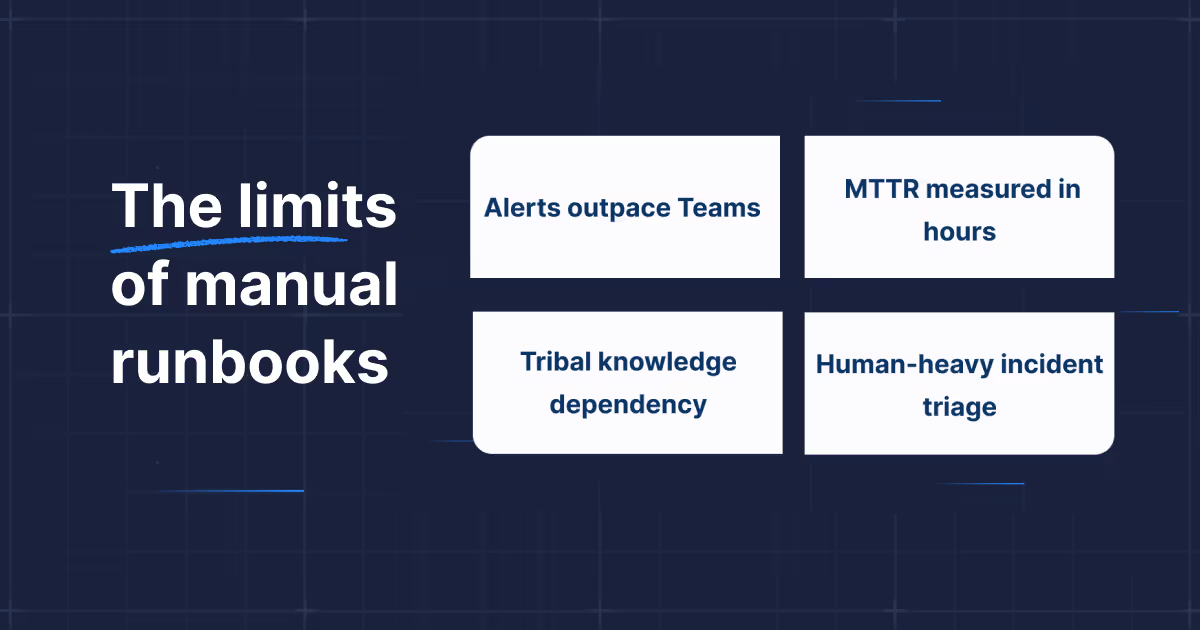
Runbooks once worked well. But systems evolved faster than our documentation could.
Our analysis shows:
- Alerts scale faster than teams can keep up with.
- MTTR still lands in hours, not minutes
- On-call engineers rely on scattered tribal knowledge
- Every incident demands human interpretation and context
Modern infrastructure is too distributed, too dynamic, and too interdependent for static runbooks to keep up. The runbook era isn’t “bad,” but it is simply outgrown.
Why incremental automation fails
Most teams start adding scripts, bots, and basic auto-remediation. It feels helpful at first until you realize the complexity outpaces your automations. The complexity of modern infrastructure doesn’t grow linearly, it augments. Distributed architectures, ephemeral compute, constant deployments, and deeply interconnected dependencies create an ever-shifting incident landscape.
Automation often falls short because it’s brittle and struggles to adapt when incidents don’t match past patterns. As scripts decay and alerts accumulate, critical knowledge remains siloed, leaving only experienced ops teams able to distinguish real issues from noise. The result is that humans still spend most of their time triaging and chasing symptoms across fragmented tools. This leads to the firefighter’s trap, where partial automation actually makes manual work harder instead of easier.
Introducing the solution: from firefighting to intelligent response
Teams now need a system that can understand their environment, interpret signals in context, and adapt as conditions change, much like a skilled medical team responding to a patient in distress.
This is the promise of agentic AI for incident response.
Unlike static tools that execute predefined rules, they offer adaptive, context-aware intelligence capable of interpreting signals, understanding dependencies, learning from each incident, and acting in ways that traditional automation cannot.
This brings us to the first major component of the AI SRE.
Context-Aware AI
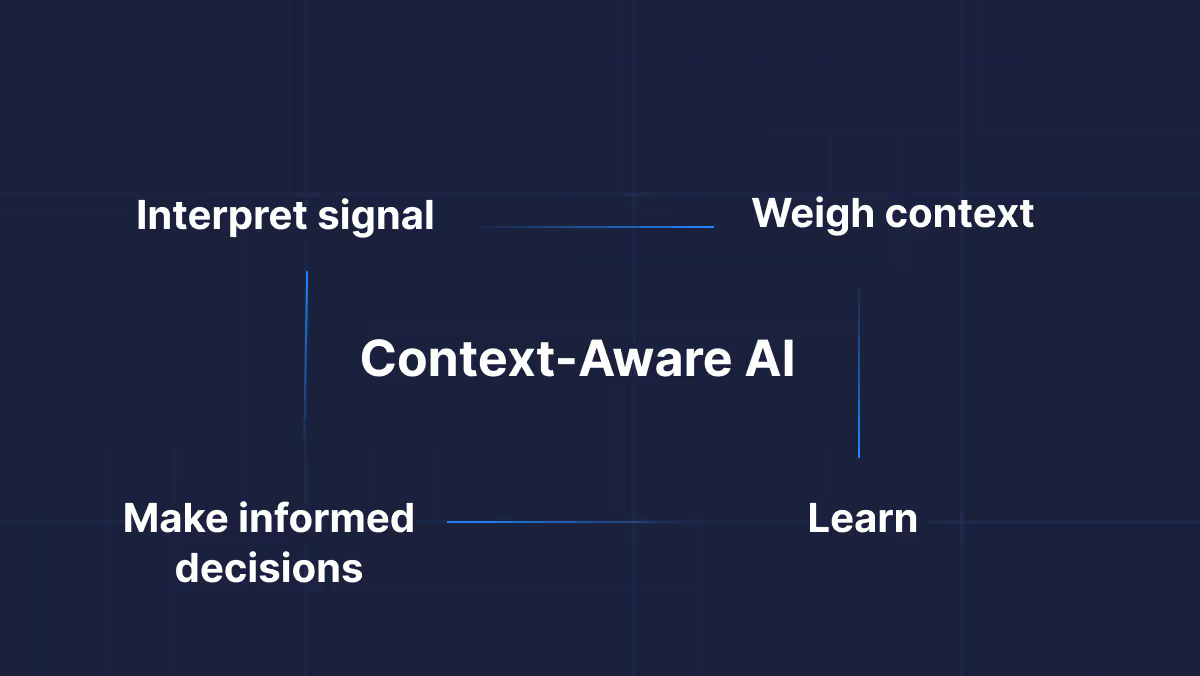
An AI-driven SRE system introduces capabilities that manual and semi-automated approaches simply cannot achieve. Instead of following rigid, linear rules, the system executes multiple interconnected steps, adapting its behavior as situations evolve. With every incident it helps resolve, the system learns, therefore continuously refining its understanding and responses.
The future of incident response is not about replacing humans, but about amplifying human expertise. AI takes on the tedious, noisy, and cognitively exhausting work that engineers should not have to carry, allowing them to focus on what truly matters. Humans remain essential. Just as doctors rely on automated monitors to track vital signs while they concentrate on diagnosing the underlying condition, agentic AI manages constant background signals so engineers can apply judgment where it has the greatest impact.
Once a system reaches this level of understanding, a new question emerges: how does it operate across complex, interconnected environments, where a visible symptom often originates from an entirely different part of the “body”?
This brings us to the second major component of the system: the shift from linear incident pipelines to a dynamic, interconnected Incident Mesh.
The “incident mesh”
Imagine incidents as signals in a living network. Problems propagate, mutate, and interlink across services. Agentic AI embraces this complexity through an Incident Mesh model. Instead of flowing through a queue, incidents become interconnected nodes the system maps and manages holistically.
This mesh model allows:
- Dynamic reprioritization as the scenario unfolds.
- Localized “cellular” remediation rather than global, blunt-force actions.
- Real-time learning and adaptation, with each resolved incident refining future responses.
Each agent owns a slice of the puzzle, much like a medical response team, with triage nurses, surgeons, and diagnosticians working together, not in sequence. This multi-agent approach only works if the underlying system is built to support it. Specialized agents need a way to collaborate, communicate, and hand off tasks seamlessly. And achieving that demands an architecture built from the ground up for multi-agent intelligence.
Blueprint: Architecting for agentic AI
Agentic AI isn’t a single bot but a coordinated system of focused, cooperating agents. Here’s what mature teams are already deploying:
- Modular agent clusters: Root-cause analysts, fixers, and communicators act in concert.
- Data-first architecture: Normalize (unify) logs, traces, tickets; protect data privacy via strict access controls and masking.
- Event-driven orchestration: Incidents are broken down into subtasks and dynamically routed to the best-fit agent.
- Built-in observability: Every agent’s action is tracked; feedback loops drive continuous improvement.
- Human-in-the-loop fallbacks: For ambiguous, high-risk scenarios, the system requests confirmation before action.
This isn’t theory: these patterns are emerging right now at engineering-first organizations tired of “spray and pray” automation.
Breaking adoption paralysis: How to start the shift
Once teams understand what agentic AI is, the next hurdle is adoption, and many teams get stuck here. It’s easy to fall into endless evaluation cycles, feature comparisons, or fears about ceding control.
Real progress starts simple:
- Audit your incident response flow. Log time spent on triage vs. diagnosis vs. remediation. What’s still manual? Where is knowledge siloed?
- Pilot agentic AI where toil is greatest. Start with routine but painful incidents – think cache clears, noisy deployment rollbacks, mass log parsing. Keep scope narrow and fully observable.
- Demand clarity. Choose frameworks where every agent’s action is logged, explainable, and reversible. No magic.
- Continuously calibrate autonomy. Don’t flip the switch to autonomous everything. Iterate, review, and let trust grow from real wins.
- Measure what matters most. Actual MTTR, alert reduction, and drop in human hours spent firefighting – not vanity metrics.
Once pilots start delivering tangible results, teams face a new question:
How do we scale autonomy responsibly?
Adaptive autonomy
Autonomy is not binary. Tune it based on risk:
- AI-led for routine, low-blast-radius fixes
- AI-with-approval for sensitive or impactful changes
- Human-led for uncertain or ambiguous scenarios
Teams, not vendors, should control the dial.
Cognitive coverage over alert coverage
Stop thinking in terms of “Do we detect everything?”
Start asking: “Does our AI understand the system’s health across all relevant dimensions?”
Map blind spots, like unmonitored dependency spikes, just as rigorously as alert coverage gaps.
This shifts the conversation from noise reduction to situational understanding.
With these principles in place, teams can expand AI SRE safely and confidently.
The point of no return: The next era through an SRE lens
Agentic AI marks a turning point for incident response. It offers a path beyond reactive firefighting and brittle automation, toward an operating model built on context, adaptability, and intelligent collaboration. For SREs and engineering teams, this shift isn’t about replacing expertise, it’s about unlocking it.
When the cognitively exhausting 80% is handled by capable agents, the remaining 20% becomes the space where human creativity, engineering judgment, and system-level thinking thrive.
If this preview clarified what’s possible, the full Agentic AI for Incident Response Guide goes deeper. It covers the architectural patterns, maturity stages, and real-world design principles needed to adopt these systems safely and effectively. It’s written to help teams move from curiosity to practical implementation and ultimately to a reliability function that accelerates, rather than absorbs, organizational complexity.
The runbook era is giving way to something new. The question now is not whether this shift will happen, but who will lead it.