Reference architecture: The blueprint for safe and scalable autonomy in SRE and DevOps



Everyone wants autonomous incident response. Most teams are building it wrong.
The ultimate goal of autonomy in SRE and DevOps is the capacity of a system to not only detect incidents but to resolve them independently through intelligent self-regulation. However, true autonomy isn't born from automating random, isolated tasks. It requires a stable foundation: a Reference Architecture.
This blueprint serves as the "immune system" of your infrastructure, ensuring that self-healing processes don't act erratically but instead operate within clearly defined guardrails. Without these principles, autonomy is a liability, like a self-driving car without sensors to monitor the road.
The reality is simple: If your autonomy strategy is built on scripts, runbooks, and reactive automation, you don’t have autonomy, you have faster failure.
In this article, we decode how to bridge the gap between manual scripting and a truly agentic strategy. We will show you why a solid architecture is the essential prerequisite for ensuring that AI-driven approaches can function safely and effectively.
- Core Principles: The theoretical foundations supporting every reference architecture.
- Building Blocks of Autonomy: The components where these principles must be applied to ensure safety.
- Incident Response: Why failure response must be hardcoded into the very heart of the architecture.
- Cloud-Native & Scaling: How modern cloud technologies redefine the implementation landscape.
Core principles of reference architecture
A reference architecture is far more than a mere recommendation or a static diagram. It is the distilled knowledge of countless failure modes and best practices. Think of it as a "constitution" for your infrastructure: it dictates how components must behave so that the overall system remains autonomously operational even under extreme stress.
Without these principles, autonomy becomes inherently unsafe, capable of acting quickly, but without the constraints needed to prevent systemic damage.
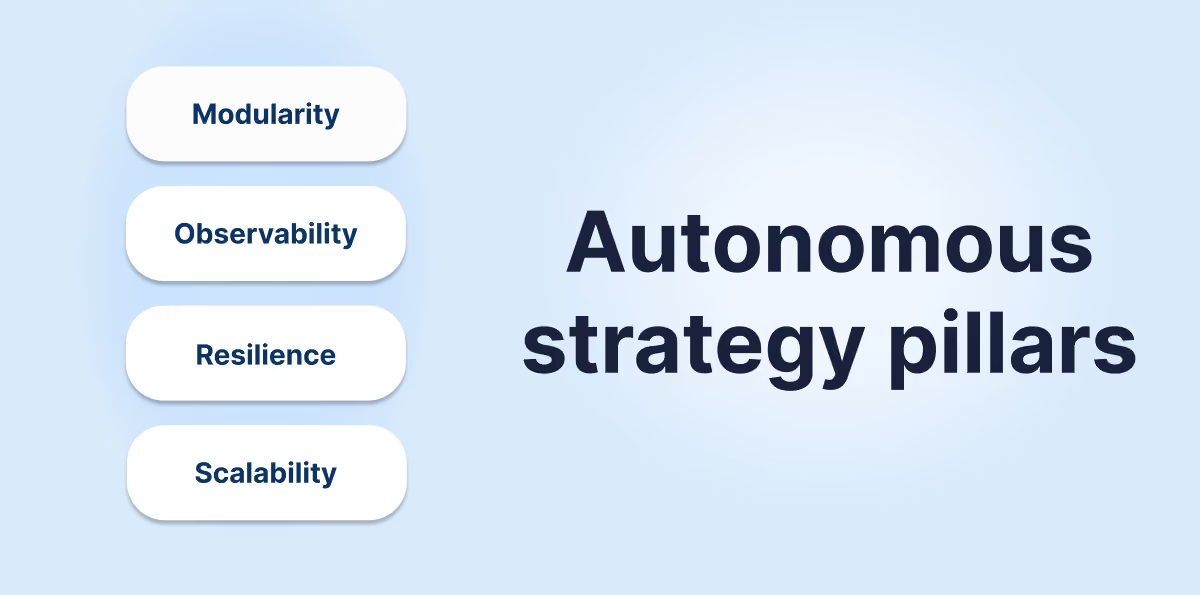
Here are the pillars upon which your autonomous strategy must rest:
1. Modularity: isolate instead of escalate
Autonomy only works if problems remain localized. By breaking down complex monoliths into independent, modular components, you ensure that an autonomous healing process in one area doesn't accidentally destabilize the entire system. Modularity is the firewall of your autonomy.
2. Observability: more than just monitoring
A system can only regulate itself if it understands its own state. This goes far beyond basic dashboards or isolated signals. True observability comes from correlating logs, metrics, and traces to build a complete, real-time picture of what’s happening across the system, enabling autonomous agents to reason about behavior, dependencies, and impact instead of reacting blindly to surface-level signals.
3. Resilience: design for failure
In an autonomous world, a failure is not an exception but a statistical certainty. A solid reference architecture anticipates outages through redundancy and failover mechanisms. The goal is graceful degradation: the system learns to "downshift" controlledly during partial failures instead of failing completely.
4. Scalability: elasticity as a reflex
True autonomy means the system reacts to load spikes before the user even notices a delay. The architecture must be designed so that resources can "breathe" elastically and without manual intervention – a reflex-like expansion and contraction based on demand.
These principles form the guardrails we mentioned in the introduction. They ensure that your system’s "intelligence" has a solid data foundation and can execute its corrections safely.
Architectural patterns for safe autonomy
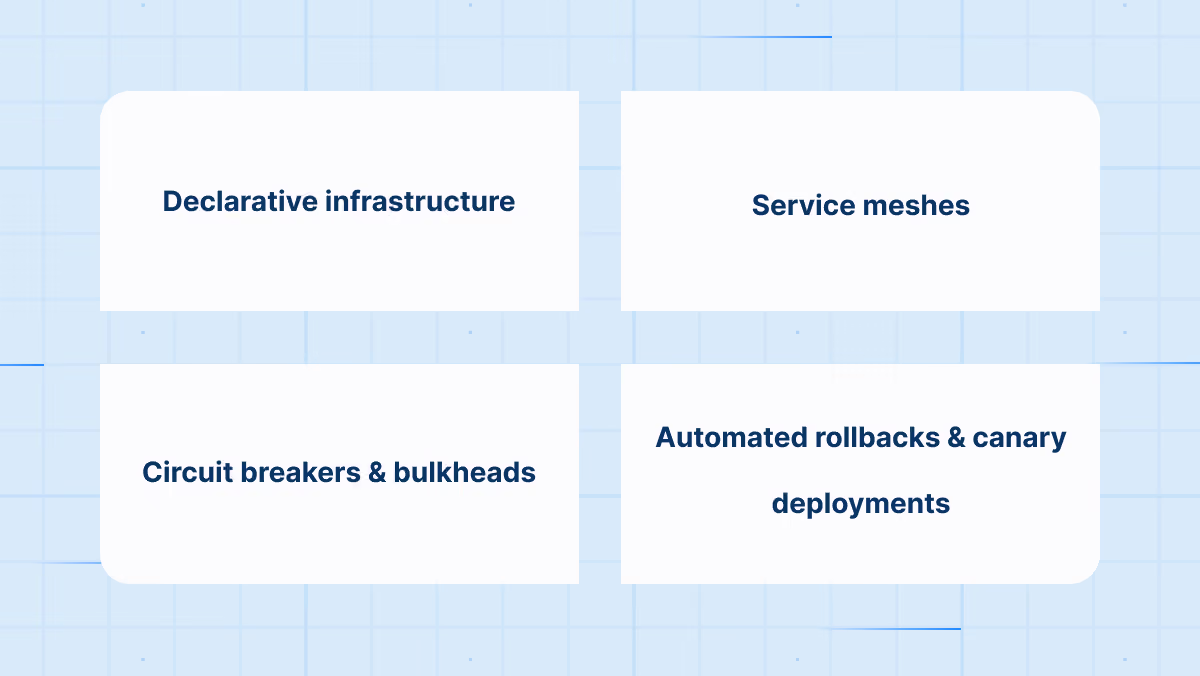
For a system to make independent decisions, the architecture must be built to support feedback loops and isolate faults. These patterns form the mechanical skeleton of your autonomous operations.
1. Declarative infrastructure (GitOps & IaC)
In an autonomous world, code is the "Single Source of Truth." With GitOps, you don't describe how to do something, but rather what the target state should be.
An autonomous controller constantly compares this target state with reality. If the system deviates (Configuration Drift), it corrects itself. GitOps is essentially the memory of your system, ensuring it always finds its way back to a healthy state.
2. Service meshes: the intelligent nervous system
Microservices alone are complex to manage. A Service Mesh adds a control plane over your services.
It enables "traffic shifting" without code changes. If a new version of a service produces errors, the system can autonomously shift traffic back to the old, stable version in milliseconds. It acts as a reflex center that reacts immediately when inter-service communication "feels pain."
3. Circuit breakers & bulkheads: the emergency fuses
These patterns are borrowed from electrical engineering and shipbuilding. A Circuit Breaker cuts the connection to an overloaded service, while Bulkheads isolate resources so that a leak in one area doesn't sink the entire ship.
They prevent cascading failures. An autonomous agent can perform "healing experiments" within a bulkhead without risking a small error taking down the entire data center.
4. Automated rollbacks & canary deployments
The risk of change is minimized through incremental introduction. A Canary Deployment rolls out updates to only 1% of users initially.
The system takes on the role of the quality auditor. It analyzes the error rate of the new version compared to the old one. If the metrics are poor, the system autonomously aborts the deployment. Here, autonomy protects the system from human error during a release.
Bridging the gap: From static defense to active response
These architectural patterns are the essential tools for stability, but on their own, they are reactive. A Circuit Breaker can stop a fire from spreading, and a Service Mesh can reroute traffic, but they don't necessarily "solve" the underlying crisis.
To move from a system that merely survives failure to one that resolves it, we must change how we view the incident lifecycle.
This is where the transition to true autonomy happens.
Incident management embedded in architecture
Incident response can no longer exist as a separate operational layer; it must be treated as a primary architectural citizen. Autonomy is only as reliable as the mechanisms that detect and react when things go wrong.
By embedding detection, alerting, and remediation directly into the reference architecture, organizations ensure that failure handling remains consistent across all services. This moves the needle from manual firefighting toward a system that understands and actively manages its own health.
In practice, this means integrating paging platforms and automated alerting hooks directly into deployment manifests. Modern architectures leverage automated runbooks that can be triggered by specific system events to resolve routine issues like memory leaks or disk saturation without human intervention.
Furthermore, incorporating chaos engineering into the architectural lifecycle allows teams to intentionally inject failure. This validates that automated response mechanisms work as expected under real-world stress, ensuring a single incident remains isolated and does not escalate into a systemic outage.
While embedding runbooks into individual services works for small environments, true autonomy requires a platform that can coordinate these responses across thousands of nodes. This is where the blueprint evolves from a set of patterns into a living, breathing ecosystem.
Scaling autonomy with cloud-native reference architecture
The rise of cloud-native technologies has fundamentally changed the blueprint for scalable autonomy. Kubernetes and its ecosystem take significant operational toil off teams through controllers and reconciliation loops, providing the "brain" that constantly steers the system back to its desired state. However, this also introduces new layers of complexity regarding coordination and security.
Achieving autonomy at scale requires more than just deploying containers; it requires a hardened infrastructure layer capable of managing its own state in distributed environments.
A robust cloud-native reference architecture focuses heavily on the guardrails of autonomy. This includes implementing fine-grained Role-Based Access Control (RBAC) and admission controllers to define exactly what automated agents are permitted to do within the cluster. Policy-enforcement layers ensure the system remains compliant even as it self-heals.
Finally, the reliability of these autonomous systems rests on a foundation of distributed consensus to maintain a "source of truth" that allows stateful applications to recover seamlessly across availability zones.
Conclusion: Building the foundation for agentic SRE
A Reference Architecture is more than a static diagram, it defines how your infrastructure is allowed to behave under stress. By codifying modularity, resilience, and scalability into your core design, you bridge the gap between manual scripts and a truly agentic strategy. However, the architecture is only the foundation. To fully realize a "lights-out" operational model, you must orchestrate the intelligence that sits atop it.
Don't leave your system's autonomy to chance. Ready to turn your architectural blueprint into an active defense? Download ilert’s Agentic Incident Management Guide to see how architecture and AI come together to create incident response that’s safe, scalable, and operationally sound.